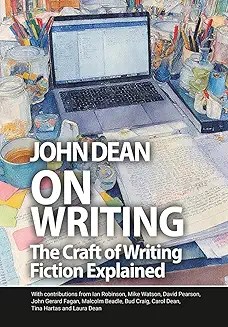
Are you an emerging writer seeking to learn about creating fiction and keen to receive plain-speaking advices? Then a book written by best-selling novelist John Dean, in which he examines the craft behind fiction, could well be for you. In On Writing, John, who is best known for his crime novels, 26 of which have been published by The Book Folks, a Joffe Books company, sets out to help emerging writers who are learning their craft and also to give readers an insight into the way writers approach fiction.
In the wide-ranging book, John, who has taught creative writing classes to student of all ages for more than twenty five years, examines everything from the creation of plots, characters and landscapes to writing with pace, beating writers’ block and editing. He also examines different genres, including crime fiction, fantasy, ghost stories and children’s books, and provides useful information which it comes to approaching publishers and agents and preparing a manuscript for self-publication. The book can be purchased in ebook and paperback format on Amazon and more information on John Dean can be found at http://www.johndeancrimewriter.co.uk
This how John begins his section on the thorny subject of how much description should you use for characters in an age of the instant image?
“So, you can see your character in your mind’s eye, sticky-up hair and all, but the challenge is how to make sure that your reader can see him/her as well. That brings us to a contentious subject that was not worth even the briefest of debates a century ago. The discussion centres round how much description a modern author should write – or perhaps ‘is allowed to write by the reader’, would be a better way of phrasing it. The debate becomes more acute when it comes to describing places, and we will return to it in the sense of place section which follows this.
The discussion has its beginnings in a time before mass media when readers expected novels to contain plenty of description because, in an age before film and television, many of them did not know much about the world in which they lived and relied on authors to tell them. The vast majority of readers not only did not know what Peru looked like, they also had no idea what a Peruvian looked like. Detailed description was needed.
The avalanche of images contained in movies and on television, and, of course, later on the Internet, meant that viewers changed dramatically when they turned their attention to what they were reading. Just as authors and publishers can create trends so can readers with the result that, having been exposed to more imagery than they had ever experienced before, modern readers in many genres have become increasingly intolerant of authors who know twenty physical things about their character and insist on listing them all in the form of an ‘information dump’, everything from the fact that are very tall, have large feet, the remnants of childhood acne and sticky-out ears to the fact that they wear pink socks and like red hats etc etc. It’s useful knowledge for you, as the writer, but there is no need to list every fact for the reader, unless it really is relevant to the story that the character likes red hats.”
 John Dean - Crime Writer
Leave a comment