February 8 2026
Report spells out dangers of AI
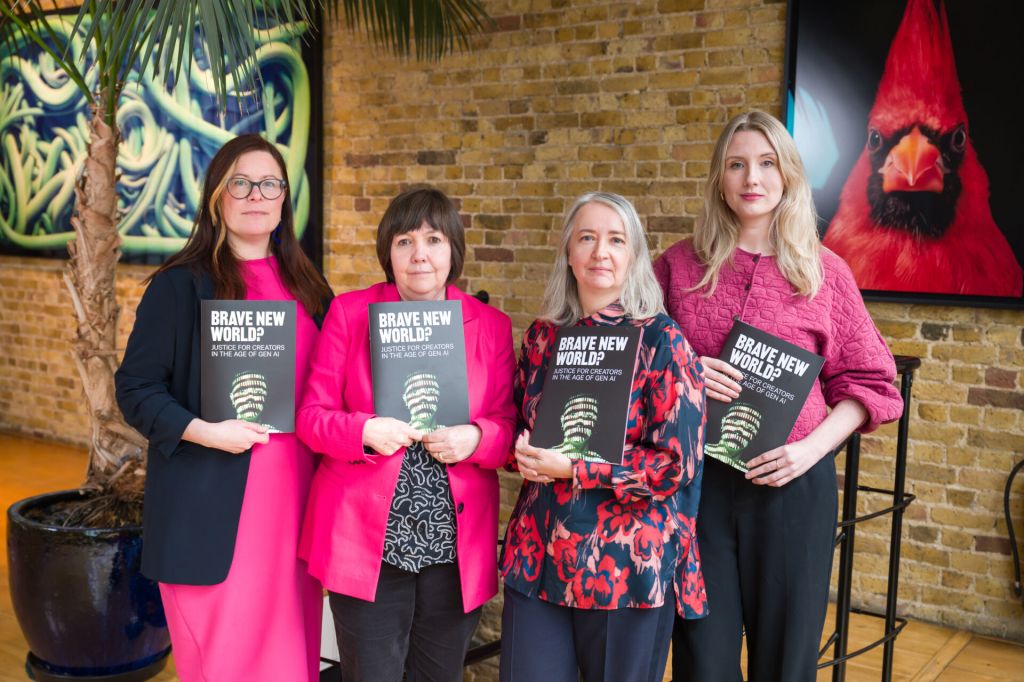
Launching the report: L to R: Anna Ganley, CEO of SoA; Deborah Annetts, CEO of ISM; Isabelle Doran, CEO of AOP and Rachel Hill, CEO of AO
The Society of Authors is among the creative sector organisations that have launched a report showing the potentially devasting impact on the sector of Artificial Intelligence (AI).
AI has been heralded as the next industrial revolution, promising an age of innovation, limitless productivity and economic growth, but the reports says that such change comes at a cost of the industrial-scale theft of the UK’s cultural riches.
Entitled Brave New World?, the report calls for the Government to a new regulatory framework to protect the livelihoods of authors, illustrators, musicians, performers, and photographers, or risk the devastation of the UK’s £124.6 billion creative industries sector.
The report uses evidence from more than 10,000 creators and is published by the Society of Authors (SoA), the Independent Society of Musicians (ISM), Equity, the Association of Illustrators (AOI), and the Association of Photographers (AOP).
Key findings include:
- 99% of creators say their work has been used without consent
- One in three creative jobs have already been lost to AI
- A third 32% of illustrators report lost commissions or cancelled projects due to AI
Authors are also hard hit:
- 86%of authors say that AI has already reduced their earnings
- 72% of authors say job opportunities have already been cut
- 57%of authors say their career is no longer sustainable
- 43% of literary translators and 37% of SoA illustrators saw earnings fall due to AI
- 26%of illustrators and 36%of literary translators report cancelled or redirected commissions.
The trade associations behind the report says the Government should set a global standard for ethical, human-centred AI deployment, with the implementation of a new regulatory framework that:
Clarifies the Copyright, Designs and Patents Act 1988(CDPA) to ensure creators’ works cannot be used to train AI models without explicit, prior consent
Supports statutory licensing scheme AI training that provides a lawful, transparent route for AI developers to access creative works, ensuring fair payment and attribution to creators
Ensures ethical use of training data creates enforceable ethical standards for the sourcing, curating and application of training data
Ensures accountability: about which copyright-protected works have been used, how they were obtained and whether they influenced outputs.
Says that Remuneration and Rights work should be attributed and paid for.
Why it’s time to take a stand against AI
I feel that it is time to address a subject which I have avoided for far too long and yet is, by far, the most important challenge that today’s writers face. I am talking about running out of teabags. No, seriously, I am referring to AI, of course. Let me be clear right from the beginning -Artificial Intelligence may be brilliant technology but I am extremely wary of the damage it can do (also, if you chuckled at my teabag quip, remember that it is highly unlikely that AI would ‘think’ to introduce it into the piece).
I have several reasons for disliking AI. One is that, having worked as a freelance journalist for twenty one years before becoming a full-time writer, I often picked up jobs to produce factual sections for magazines, books and websites. It is not too dramatic to say that I believe AI represents a potentially fatal blow to the world of freelance and in-house journalists because it will be seen as a better, and more importantly, cheaper way of doing such work.
I can see the argument used in other business sectors that computers can do the ‘boring’ stuff, leaving the more creative work to human beings but we all know that in too many cases it does not work like that. An editor faced with a journalist who says that producing a feature will take a couple of days when they include the writing and researching, will inevitably be tempted by the idea of asking AI to do it and it arriving in twenty minutes – and for a fraction of the cost charged by the pesky human, who has just rung to say that the article will not be with them until tomorrow because the dog has to go to the vet.
I would make one exception; I can see the benefit in AI ploughing through medical research that would take a team of humans years to analyse, particularly if it is work so vast that it would not be done otherwise and the outcome dramatically shortens the wait for new treatments.
However, that is my only exception and I believe that humans should still be used for the vast majority of work. That does not just relate to journalists, it also covers book editors, proofreaders, designers, public relations people, marketing specialists, publishers, literary agents etc. These are highly skilled people who bring a unique human judgement to the task. I hate the idea of them being replaced by AI.
Then there is the quality of AI’s writing. Like many authors, I have had features written about me with the journalist bringing their powers of observation and judgement into play to produce something unique. I may not always like the result but as long as it is factual, I can’t really object. That’s the value of getting a human to write the piece.
However, there are also profiles of me online that I assume were written by AI – I say ‘assume’ because no one interviewed me or told me that the profile was being done. I am guessing they were written by AI because they are 90% accurate (there is the odd factual error but that could be said of humans, of course) but the final piece lacks the creativity that a human would bring. It is bland and lacking something – I am thinking of one piece in particular that would be hugely flattering were it not spewed out by rote. AI does not bring that crucial judgement to the task that a human does.
And so finally we come to authors. AI, if asked to produce a novel/non-fiction book/collection of short stories/play/screenplay, can come up with something perfectly serviceable but it will be lacking the individual touch that the author brings to the job. If you take the genre in which I work, crime fiction, that could mean that the end result is lacking the inspired twist, unique motive, deep, dark secret, brilliant Red Herring that humans bring to the job and which make reading (and writing) crime fiction such a joy.
I am extremely wary of those who advocate a greater role in the process for AI, editing/ checking grammar etc (and I have heard it from some authors). We have to take a stance and take it now. I know that in many ways it is too late – that the genie cannot be shoved back into the bottle but, as an industry, we must guard against the dangers at all times, otherwise we run the risk of losing something special as authors and associated crafts become an endangered species.
And, finally, an author’s cautionary tale about Artificial Intelligence
I am at the age when dementia becomes a consideration – my father died with it, as you may have read in this book – so I became somewhat concerned over developments on my laptop over several weeks recently. I would return to the previous day’s writing on my laptop for a quick refresh before moving on, only to find that occasional sentence that I did not recognise, or remember writing, had appeared in the text. They were not written in my style and sometimes used words that I do not.
Finally., I had my answer and, thankfully, it is not dementia, although the alternative, which I had suspected for a while, does not put the mind at rest. My laptop, like so many of the new designs, has an inbuilt AI system, there whether I like it or not (for the avoidance of doubt, Not). The programme keeps pestering me to help with the editing or write new passages (it even asked if it could cook my dinner!) but I either say ‘no’ or ignore it and it goes away until its next attempt. One writer I know became so angry, she typed a four-letter word and the AI programme admonished her for being rude.
Anyway, back to the story. One of the word files I have on my desktop is a kind of dumping ground – it contains regularly used phone numbers, the occasional line from my in-progress novels which I do not need but may do so eventually, vague plot ideas, names yet to be allocated to fictional characters etc etc.
I must have inadvertently clipped the AI symbol while working on my latest novel recently because the programme produced half a page of text using what was already there in my dumping ground, starring my fictional names, weaving in the spare sentences and dropping in the numbers, all worked into the rudimentary semblance of plot. It’s not particularly good but that’s not the point –I am the writer, and what’s more, it could be risky – what if next time (the icon is hovering next to this word document, as I write this and I can’t get rid of it) without me noticing, it drops its text on a page that I think is finished and do not intend to return to? What if the next person to read it is the publisher/agent?
There is one good thing to come out of this little episode, it’s given me a great idea for a novel!
 John Dean - Crime Writer